

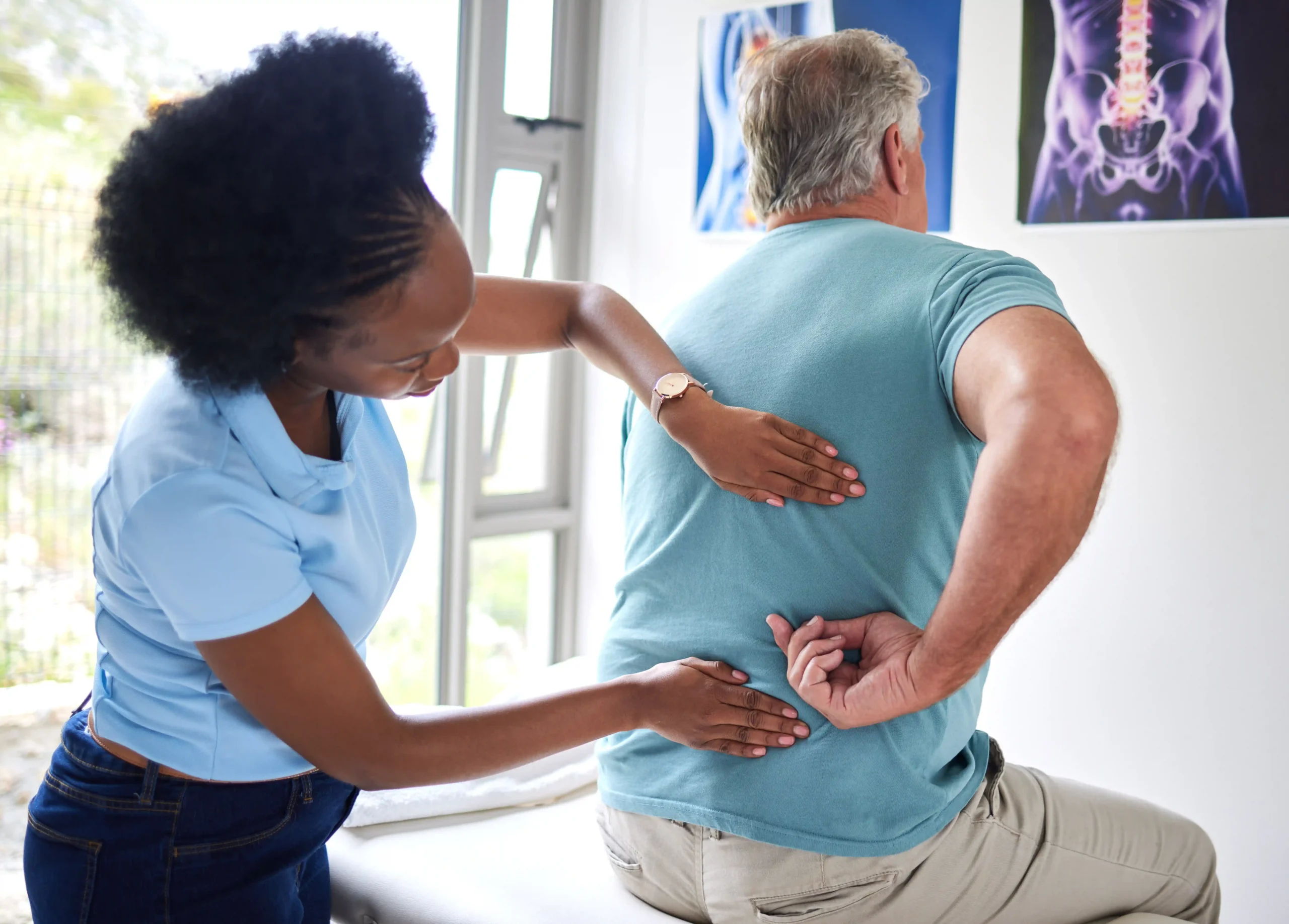
Lower back pain after car accident Brick, NJ drivers and passengers report is often blamed on a simple muscle pull, yet the forces involved in a collision are far more complex. The lumbar spine is built to support body weight and permit controlled bending, not to absorb sudden compression, twisting, and shear delivered through a seat and a lap belt. Injuries to the facet joints, intervertebral discs, nerve roots, and sacroiliac joints can remain hidden beneath what feels like general stiffness. This guide explains how crash forces reach the lower back, which structures are most vulnerable, and how a mechanics-focused rehabilitation plan addresses them.
How a Collision Loads the Lumbar Spine
At impact, the vehicle changes speed abruptly while the occupant’s body is restrained at the pelvis and shoulder. The pelvis is held by the seat and belt, while the upper body continues in its original direction. The lumbar spine sits between these two moving masses and is forced to absorb the difference through compression, flexion, extension, rotation, and shear, often in combination.
Axial Compression Through the Seat
When a vehicle is struck from behind or drops sharply over an impact, force can travel upward through the seat into the pelvis and spine. This axial compression loads the vertebral bodies and discs, squeezing the soft inner disc material outward. A disc that is already degenerated or previously irritated may be especially susceptible to displacement.
Pelvic Shear and Rotational Strain
Because the pelvis is anchored while the trunk twists, shear forces develop across the lower lumbar levels, particularly where the spine meets the pelvis. This shear can strain the facet joint capsules and the stabilizing ligaments, and it is a common contributor to pain that feels deep, band-like, and difficult to localize.
The Foot-on-Brake Bracing Effect
Drivers frequently brace by pressing the brake pedal and gripping the wheel an instant before impact. This posture drives force up the leg and through the pelvis, rotating the hip and concentrating stress on the sacroiliac joint and lower lumbar segments. The bracing response is natural, but it means the driver’s low back and pelvis can absorb more load than passengers experience.
Structures Commonly Involved in Post-Crash Lumbar Injury
Several tissues can contribute to symptoms, often simultaneously:
- Lumbar facet joints: small paired joints behind the vertebrae that can become inflamed from compression or sudden extension, producing localized, achy pain that may worsen with arching or standing.
- Intervertebral discs: forceful flexion and compression may lead to bulging or displacement, sometimes irritating adjacent nerves.
- Nerve roots: compression can produce radiating pain, numbness, or tingling into the buttock or leg, consistent with lumbar radiculopathy.
- Sacroiliac joints: misalignment or strain here often presents as pain on one side of the lower back, near the dimple of the buttock.
- Paraspinal and hip stabilizers: protective spasm and strain produce stiffness that further limits movement.
Understanding Lumbar Facet Syndrome and Nerve Root Compression
Lumbar facet syndrome describes pain generated by irritated facet joints. It commonly appears as a dull ache with stiffness, often aggravated by standing, extending the spine, or rising from a seated position. Nerve root compression behaves differently. It tends to produce symptoms that travel, such as sharp or electric pain, numbness, or weakness extending below the waist. Distinguishing between these patterns helps direct care toward the correct structure, which is why a detailed examination matters more than guessing from pain location alone.
Why Symptoms May Surface After the Initial Shock
Many people feel only mild discomfort at the scene. Inflammatory chemicals accumulate in injured tissue as the body begins to repair damage, and protective muscle spasm tightens over the injured segments. Pain, stiffness, and limited motion may become more noticeable as these processes mature. Because disc and facet injuries do not always produce immediate sharp pain, dismissing early stiffness can allow compensatory movement patterns to develop. Those patterns can strain the hips, mid-back, and opposite side of the body.
The Clinical Evaluation Process
A thorough evaluation for lower back pain after car accident Brick, NJ residents seek help for starts with a detailed history of the collision, including vehicle position, direction of impact, and the occupant’s posture. The examination then typically includes:
- Observation of posture and gait for compensation patterns
- Range of motion testing in flexion, extension, side bending, and rotation
- Palpation of joints and soft tissue to identify tenderness and restriction
- Orthopedic tests that stress the facet joints, discs, and sacroiliac joints
- Neurological screening of strength, sensation, and reflexes in the lower limbs
When findings suggest a need, referral for imaging or coordination with other specialists helps confirm or exclude disc injury, fracture, or other pathology. Documenting each finding objectively also builds a clear medical record of the condition and its progress.
Principles of Auto Accident Back Pain Treatment Brick, NJ Patients Can Expect
Effective auto accident back pain treatment Brick, NJ providers offer is built around restoring mechanics, not just quieting symptoms. Patients exploring back pain treatment typically encounter several coordinated components.
Gentle Mobilization and Biomechanical Realignment
Techniques are chosen to restore motion in restricted lumbar and sacroiliac joints while respecting tissue sensitivity. Low-force approaches are often favored when inflammation is high, and progression is guided by tolerance rather than a fixed script.
Spinal Decompression Strategies
Flexion-distraction and similar decompression-oriented approaches aim to gently reduce pressure on irritated discs and nerve roots by creating space between segments. Candidacy depends on examination findings, and these methods are used selectively as one part of a broader plan rather than as a standalone solution.
Soft-Tissue Therapy
Targeted work on the lumbar paraspinals, gluteals, and hip flexors can ease protective spasm and improve circulation. Calmer muscles make joint work more comfortable and support better movement quality.
Core and Pelvic Stabilization
As pain eases, exercise shifts toward restoring the deep abdominal, multifidus, and gluteal muscles that stabilize the lumbar spine. Strong, coordinated stabilizers reduce repetitive loading on healing joints and discs, supporting long-term functional stability.
Integrating Back Care with Broader Accident Recovery
Back injuries rarely occur alone. The same forces that load the lumbar spine can strain the neck, shoulders, and hips. Coordinated approaches that follow auto accident chiropractic care principles address these regions together, so that one area is not rehabilitated while another continues to compensate. Everyday adjustments such as supportive seating, regular position changes, and safe lifting mechanics also help protect healing tissue while rehabilitation progresses.
Red Flags That Warrant Immediate Medical Attention
Seek emergency care promptly if lower back pain is accompanied by loss of bladder or bowel control, numbness in the groin or saddle area, progressive leg weakness, severe unrelenting pain, or unexplained fever. These findings can signal serious spinal or neurological involvement that takes priority over any outpatient plan.
Recovery Milestones to Watch For
Progress is best measured by function. Meaningful indicators include easier transitions from sitting to standing, improved bending and rotation, reduced radiating symptoms, more comfortable driving and sleeping, and greater confidence with lifting. Recovery differs between individuals, and no specific outcome can be promised, but tracking these markers keeps care purposeful and adaptable, which is the practical aim of auto accident back pain treatment Brick, NJ patients pursue.
Final Thoughts
Lumbar injuries from collisions are rarely simple, and the combination of compression, shear, and bracing can affect discs, joints, and nerves at once. Identifying the true source and rebuilding stability around it gives patients a more dependable path forward than rest alone. For those dealing with lower back pain after car accident Brick, NJ roads can cause, the clinical team at Personal Injury Doctor Brick NJ offers careful examination and structured rehabilitation designed around objective findings and meaningful functional milestones.
Frequently Asked Questions
Can lower back pain appear after a minor collision?
Yes. Even lower-speed impacts can generate compression and shear sufficient to irritate facet joints, discs, or the sacroiliac joints. The severity of vehicle damage does not always reflect the force transmitted to the spine.
How can I tell whether the pain is muscular or involves a disc?
Muscle strain tends to feel tight and localized, while disc or nerve involvement may produce radiating pain, numbness, or tingling into the leg. Only a clinical examination, and sometimes imaging, can distinguish them reliably.
Why do I feel pain on one side near the pelvis?
Pain concentrated on one side of the lower back, close to the pelvis, may involve the sacroiliac joint. Bracing against the brake pedal or a rotated posture at impact can load that joint unevenly.
Is spinal decompression appropriate for everyone?
No. Decompression approaches are considered only after examination confirms they fit the injury pattern, and they are typically combined with mobilization, soft-tissue therapy, and stabilization exercises.